Port machinery cables are a specialized category of cables critical for the operation of modern container terminals. Installed in cable reels and festoon systems on massive, moving equipment, these cables are subject to a unique combination of mechanical, environmental, and electrical stresses that standard industrial cables cannot endure.
1.(Core Design Challenges)
The design addresses several extreme conditions:
-
Continuous Torsion: Cables on revolving cranes, such as the boom of a ship-to-shore crane, are subjected to continuous twisting (un-twisting and re-twisting) as the crane moves. The cable must be engineered for a specific torsion angle (e.g., ±180°/meter) without damaging internal conductors.
-
Flexing and Bending: Cables used in festoon systems for RTGs experience continuous bending cycles as the crane travels back and forth.
-
Harsh Environmental Conditions: Exposure to intense UV radiation, ozone (from electrical arcing), salt-laden air, moisture, and wide temperature swings (-25°C to +70°C) can rapidly degrade standard cable materials.
-
Mechanical Abuse: Potential for crushing, impact, and abrasion during operation and maintenance.
2. (Key Design & Construction)
-
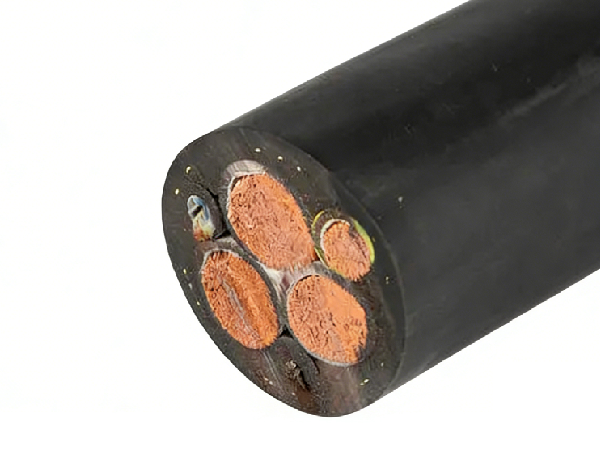
Conductors: Extra-fine, high-flexibility copper strands are used. The stranding is optimized for torsion, often with a special lay length and direction to allow conductors to move relative to each other without breaking.
-
Insulation: Specialized elastomer materials like Torsion-Optimized PVC or Cross-Linked Polyethylene (XLPE) are used for their flexibility, durability, and resistance to cracking under stress.
-
Sheathing (Jacket): The outer jacket is the first line of defense. Materials like Chlorinated Polyethylene (CPE), Polyurethane (PUR), or specially formulated PVC are chosen for their exceptional resistance to:
-
UV & Ozone: Prevents cracking and degradation.
-
Salt Water & Chemicals: Resists corrosion.
-
Abrasion & Tearing: Withstands physical wear and tear.
-
Cable Core Design: The internal components are often bundled with a slip layer (e.g., PTFE tape) to allow them to move during torsion, reducing internal stress. A central strain relief element may be included.
3. (Common Types)
-
Power Cables: For supplying high current to crane hoists, trolleys, and drives.
-
Control & Data Cables: For transmitting control signals to drives, PLCs, and feedback from encoders and sensors. Often include shielding (Foil + Braid) for EMI protection.
-
Hybrid/Composite Cables: Combine power, control, and data (e.g., fiber optics) conductors in a single cable to simplify installation and reduce weight on the cable reel.
-
Torsion-Specific Cables: Rated for a defined number of torsion cycles (e.g., 5,000 cycles at ±180°/m) under specific load conditions.
4. (Applications)
-
Ship-to-Shore (STS) Cranes
-
Rubber-Tired Gantry (RTG) Cranes
-
Rail-Mounted Gantry (RMG) Cranes
-
Stacking Cranes and ASCs (Automated Stacking Cranes)
-
Container Handlers and Straddle Carriers