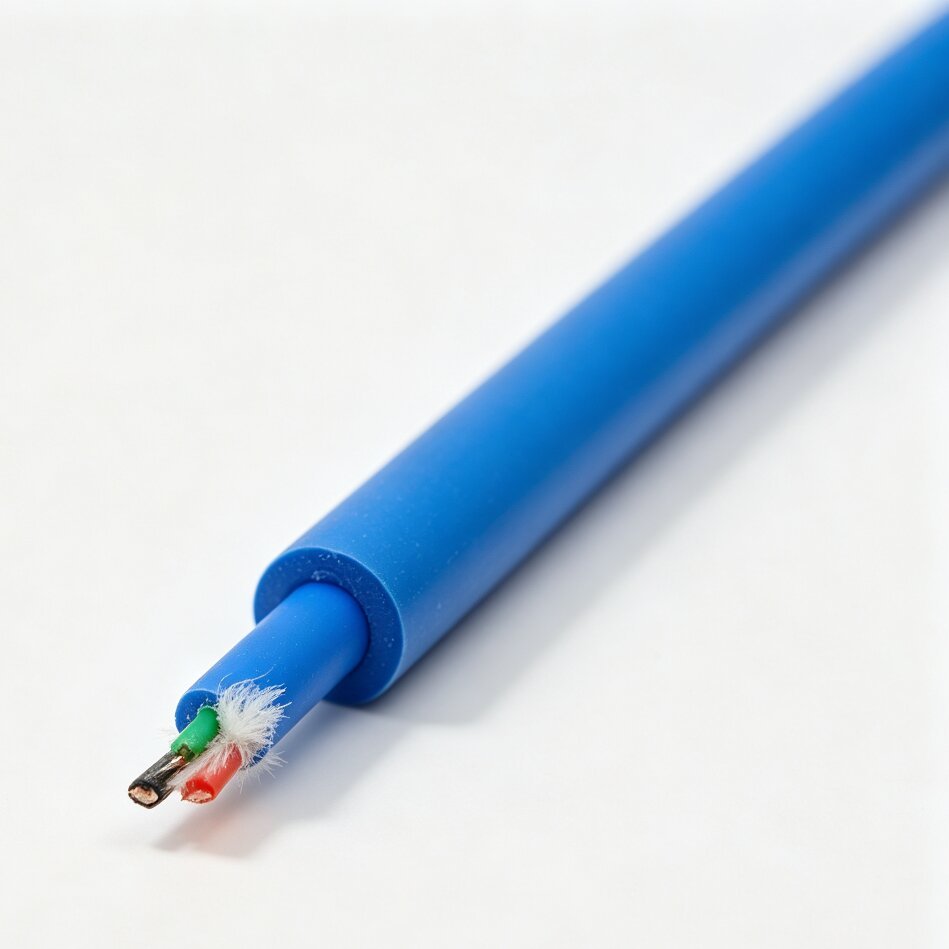
An underwater cable is a critical link in the sonar system, directly impacting the system’s maximum range, resolution, and data fidelity. It is an electro-mechanical assembly that must perform two primary functions simultaneously: efficiently deliver high-power electrical energy and faithfully transmit low-power returning signals, all while enduring a harsh marine environment.
1. (Core Functions & Electrical Requirements)
-
Transmit Path (High Power): The cable must carry high-voltage, high-current electrical pulses from the sonar transmitter on the vessel to the transducer (the “speaker” that generates sound waves) with minimal power loss.
-
Receive Path (High Sensitivity): After the sound wave echoes off an object, the transducer (now acting as a “microphone”) generates an extremely faint electrical signal. The cable must transmit this weak signal back to the surface receiver with absolute minimal degradation, attenuation, or introduction of noise.
2. (Key Design & Construction)
To meet these demanding requirements, sonar cables feature a sophisticated construction:
-
Center Conductor: A high-purity copper conductor is used for its excellent electrical conductivity.
-
Dielectric Insulation: A high-quality dielectric material (e.g., foam polyethylene) surrounds the center conductor. This material is chosen for its stable characteristic impedance (usually 50Ω or 75Ω) and low signal attenuation (loss) per meter.
-
Shielding: This is arguably the most critical element. Multiple layers of shielding are common:
-
Braid Shield: A high-coverage (often >95%) tinned copper braid provides excellent protection against electromagnetic interference (EMI) and serves as the return path for the electrical current.
-
Foil Shield: An underlying aluminum-polyester foil tape provides 100% coverage against high-frequency noise.
-
Strength Member: For towed arrays or deep-water applications, the cable incorporates a central strength member made of aramid fiber (e.g., Kevlar®) or steel wire to handle the towing tension and the weight of the array.
-
Jacket: The outer jacket is made from tough, abrasion-resistant materials like polyurethane (PUR) or PVC, resistant to seawater, sunlight, and chemicals. It is often brightly colored (e.g., orange) for high visibility.
3. (Types of Sonar Cables)
-
Coaxial Sonar Cable: A single coaxial core for simpler systems. May be bundled with strength members within an overall jacket.
-
Hybrid Sonar Cable: Incorporates multiple coaxial elements for multi-beam sonars, along with separate twisted pairs for powering auxiliary sensors and data communication, all integrated around a central strength member.
-
Towed Array Cable: Specifically designed for towing behind a vessel, featuring streamlined hydrodynamic characteristics, high tensile strength, and sometimes built-in stress relief.
4. (Applications)
-
Naval and Defense Sonar Systems
-
Hydrographic Survey and Seabed Mapping
-
Fisheries Research
-
Offshore Oil & Gas Exploration (seismic surveys)
-
Underwater Search and Recovery Operations
-
Scientific Research Vessels