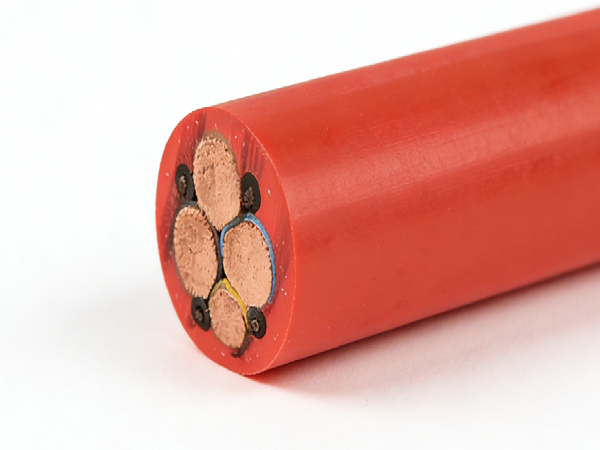
Grab cables serve as indispensable wiring parts within bulk material handling systems for motor-driven grab devices. Normally coiled onto crane-mounted cable reels and linked directly to grabs, these cables deliver power for grab drive motors and transmit control signals synchronously. What distinguishes grab cables from ordinary flexible wires is their capacity to withstand multi-dimensional mechanical loads. Aside from cyclic bending, they must cope with powerful torsional strain generated when the grab rotates throughout loading and unloading cycles.
1. Core Operational Loads
Torsional Load: This poses the biggest test for grab cables. Constant rotation of the grab during cargo handling forces the cable to twist forward and backward repetitively. High-quality cables are engineered to survive specified torsion cycles, such as ±180° per meter over 5,000 cycles, while preventing internal conductor breakdown.
Bending Load: Continuous winding and unwinding on cable reels, paired with the dynamic movement of the grab, subjects the cable to recurring bending stress.
Mechanical Damage Risks: On-site operation brings risks such as collisions, compression from falling bulk goods, plus friction against vessel surfaces, bulk cargo and ground surfaces.
Complex Environmental Conditions: These cables frequently operate in demanding surroundings with UV rays, ozone erosion, coastal salt mist, extreme temperature fluctuations, and possible contact with lubricants and grease.
2. Structural Design & Material Configuration
Conductors: Extra-fine stranded tinned copper conductors are widely adopted. The tin coating enhances anti-corrosion performance against humid environments. Custom stranding pitch and twisting directions are applied to offset torsional force effectively.
Insulation: Premium Ethylene Propylene Rubber (EPR) and Thermoplastic Elastomer (TPE) act as primary insulation materials. Compared with conventional PVC, they maintain flexibility under low-temperature conditions and resist cracking or permanent deformation after long cycles of mechanical stress.
Outer Sheath: The sheath largely determines the cable’s service lifespan. Chloroprene Rubber (CR / Neoprene) and Polyurethane (PUR) are top options, featuring outstanding properties as below:
- Superior anti-abrasion and anti-tear performance
- Strong resistance to weather aging and ozone
- Reliable protection against oil and chemical contamination
Internal Structure: Cable cores are assembled with optimized stranding layout to allow relative displacement under twisting conditions. Some variants adopt central synthetic fiber torsion-resistant reinforcements to dissipate torsional stress and safeguard conductive cores. Balanced overall structure avoids spontaneous cable twisting during operation.
3. Main Product Categories
Power Grab Cable: Equipped with large cross-section conductors to supply electricity for grab driving motors.
Control Grab Cable: Smaller gauge cores transmit commands to manage grab opening and closing; shielded versions are available for anti-interference needs.
Hybrid Grab Cable: Integrated composite cable incorporating power cores, signal control cores, and optionally pilot lines or optical fiber for data transmission within one outer sheath. It streamlines installation and simplifies cable management on cranes.
4. Typical Application Scenarios
- Port and bulk terminal grab cranes
- Metal scrap handling lifting equipment
- Ore and mining handling machinery
- Orange-peel grabs for construction waste disposal
- Clamshell grabs for bulk cargo including coal, grain and gravel